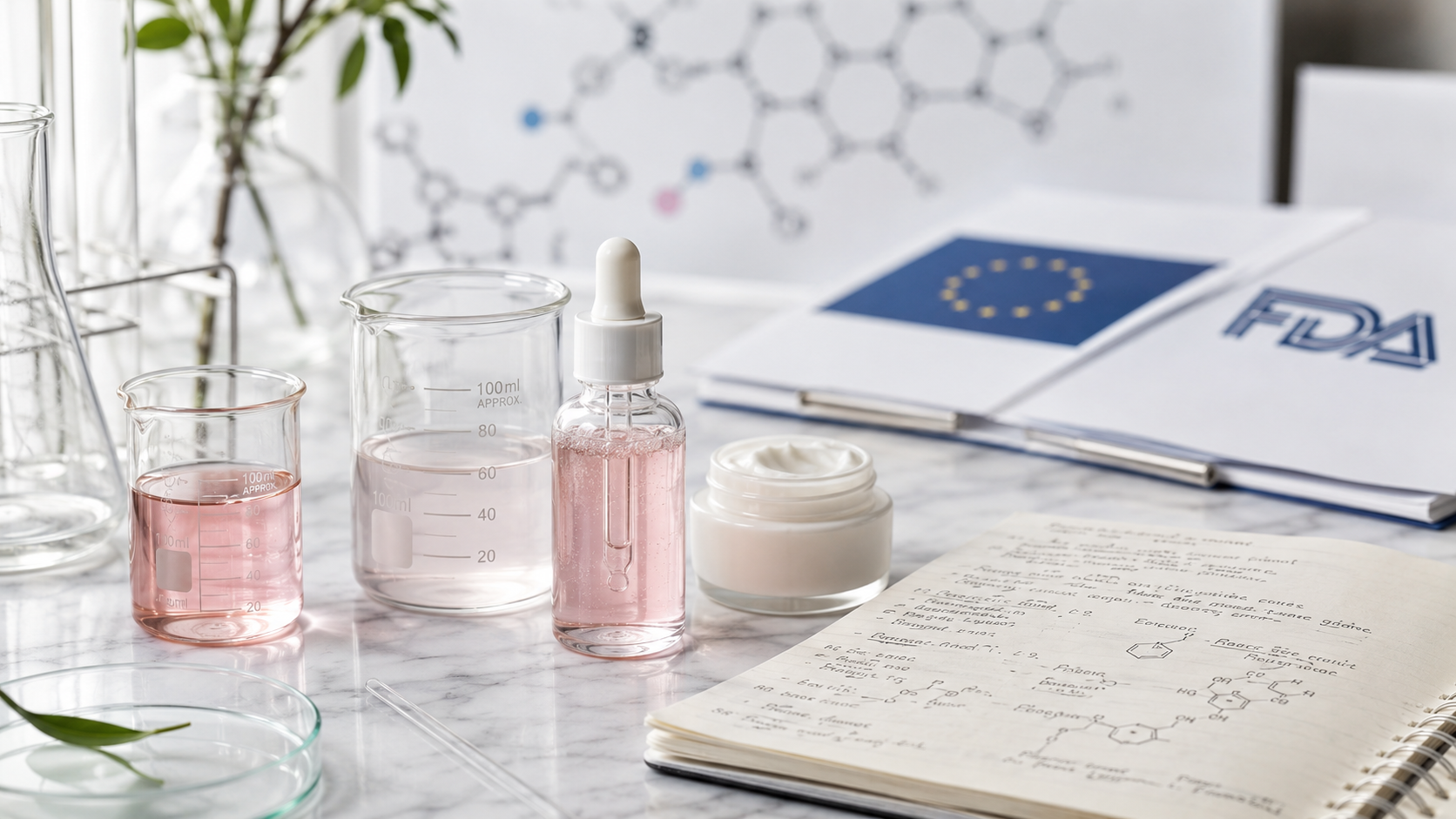
The Global Landscape of Cosmetic Regulation: What Brands Need to Know in 2026
From the EU's stringent INCI requirements to the FDA's voluntary registration program, cosmetic brands face a complex patchwork of global regulations. Here's your essential guide.
Introduction
The cosmetic industry operates at the intersection of science, safety, and increasingly complex international law. Whether you're a solo formulator launching a debut serum or a global brand expanding into new markets, understanding cosmetic regulation is no longer optional — it's the foundation of responsible beauty.
This article breaks down the key regulatory frameworks across the world's largest beauty markets, highlights the most common compliance pitfalls, and explains why staying ahead of regulation is a competitive advantage, not just a legal obligation.
The Three Major Regulatory Regimes
1. European Union — The Gold Standard
The EU operates under Regulation (EC) No 1223/2009, widely regarded as the world's most comprehensive cosmetic safety framework. Key requirements include:
- Product Safety Report (PSR): Every cosmetic product must have a documented safety assessment conducted by a qualified safety assessor before market entry.
- Cosmetic Product Notification Portal (CPNP): All products must be notified to the EU-wide database before sale.
- INCI labeling: Ingredients must be listed using International Nomenclature of Cosmetic Ingredients names, in descending order of concentration.
- Responsible Person (RP): An EU-based entity must be designated as legally accountable for each product.
The EU Annex II lists over 1,400 prohibited substances. Annex III covers restricted substances with specific usage limits, and Annex IV–VI govern colorants, preservatives, and UV filters — each with an allowed-substances list rather than a prohibited-only approach.
Key trend: The EU is actively updating its restricted substances lists under the Green Deal and Chemicals Strategy for Sustainability, with microplastics, per- and polyfluoroalkyl substances (PFAS), and endocrine-disrupting chemicals (EDCs) under active review.
2. United States — Regulatory Modernization in Progress
The FDA has historically regulated cosmetics under the Federal Food, Drug, and Cosmetic Act (FD&C Act), which was significantly updated by the Modernization of Cosmetics Regulation Act of 2022 (MoCRA) — the most substantial reform since 1938.
MoCRA introduces:
- Facility Registration: Cosmetic manufacturers and processors must register with the FDA.
- Product Listing: All marketed cosmetic products must be listed, including a full ingredient declaration.
- Serious Adverse Event Reporting: Manufacturers must report serious adverse events to the FDA within 15 days.
- Substantiation of Safety: Companies must maintain safety records, though the standard is less prescriptive than the EU's PSR.
Unlike the EU, the US operates on a prohibited/restricted list model (not a positive list), meaning ingredients are permitted unless specifically restricted. The FDA's current prohibited list contains far fewer substances than the EU's — approximately 11 vs. 1,400+.
3. ASEAN, China, and Emerging Markets
China requires pre-market registration for "special use" cosmetics (sunscreens, hair dyes, skin-lightening products) and notification for general cosmetics. Since 2021, China's Regulation on the Supervision and Administration of Cosmetics introduced new ingredient safety data requirements and a novel ingredient registration pathway.
ASEAN member states follow the ASEAN Cosmetic Directive, which closely mirrors EU Regulation 1223/2009, making EU-compliant products generally adaptable across Southeast Asian markets.
Canada operates under the Food and Drugs Act and maintains its own Hotlist of prohibited and restricted ingredients, largely aligned with EU standards but with distinct thresholds and conditions.
The INCI System: The Universal Language of Ingredients
The International Nomenclature of Cosmetic Ingredients system, maintained by the Personal Care Products Council (PCPC) and adopted globally, serves as the lingua franca of cosmetic formulation and regulation.
INCI names are assigned based on scientific names (Latin for botanicals, chemical names for synthetics). Correct INCI labeling is non-negotiable in the EU, Canada, and increasingly required or expected in most markets.
Common pitfalls:
- Using trade names instead of INCI names
- Incorrect concentration ordering (must be descending above 1%; below 1% can be listed in any order)
- Missing or incorrect INCI for fragrance components (especially with allergen disclosure requirements)
Prohibited Substances: Where Brands Get Caught
The divergence between US and EU permitted substances is where international brands most often run into problems. Some examples of ingredients permitted in the US but restricted or banned in the EU:
IngredientUS StatusEU Status
Formaldehyde-releasing preservatives
Permitted
Restricted (concentration limits)
Oxybenzone (Benzophenone-3)
Permitted
Restricted (max 6%)
Hydroquinone
OTC drug (cosmetic use banned)
Banned (Annex II)
Certain azo colorants
Permitted
Prohibited
Triclosan
Banned in soaps (permitted in other cosmetics)
Restricted
Claim Substantiation: The Silent Compliance Risk
Regulatory compliance isn't limited to ingredients. Product claims — "clinically tested," "dermatologist approved," "reduces wrinkles by 40%" — must be substantiated by evidence that meets the evidentiary standard of the target market.
The EU's Common Criteria for the Justification of Claims (Commission Regulation 655/2013) sets six principles: legality, truthfulness, evidential support, honesty, fairness, and informed decision-making.
The FTC's Green Guides and FDA's OTC drug guidelines further constrain what brands can claim in US markets.
Building a Compliance-First Formulation Workflow
Modern cosmetic brands are moving toward compliance-by-design — building regulatory checks into the formulation process rather than treating compliance as a final gate.
Best practices include:
- Screen ingredients at ideation — check every raw material against target-market prohibited/restricted lists before finalizing a formula.
- Maintain a real-time INCI database — ensure trade-name-to-INCI mappings are current and verified against official PCPC and EU CosIng databases.
- Track regulatory updates — the EU publishes Annex amendments regularly; China's NMPA issues ingredient safety assessments continuously.
- Document everything — a Product Safety Report is only as strong as the data behind it.
- Use digital compliance tools — modern formulation platforms can automate restriction screening across multiple geographies simultaneously.
What's Coming: Regulatory Trends to Watch
Microplastics restriction: The EU is finalizing a broad restriction on intentionally added microplastics, including certain polymers used as film formers, glitter, and exfoliants.
Endocrine disruptors: The EU is developing criteria to identify EDCs in cosmetics; this will likely expand the restricted substances list significantly.
Blockchain and supply chain transparency: Emerging regulatory interest in traceability — knowing not just what's in a product but where every ingredient came from.
AI-assisted safety assessment: Regulators in the EU are exploring in silico (computer-modeled) toxicology as a pathway to reduce animal testing while maintaining safety standards.
Conclusion
Cosmetic regulation is neither static nor simple. It is a living framework that reflects society's evolving understanding of ingredient safety, environmental impact, and consumer rights. Brands that treat compliance as a strategic capability — not a checkbox — will be better positioned to launch faster, scale globally, and build lasting consumer trust.
The most effective compliance programs are the ones that start at the bench, not the legal department.